
Union County Prospective Release Dates
Oregon's public systems use two exact labels. The legacy Oregon Offender Search, or OOS, can show an Earliest Release Date. VISOR uses projected release date (PRD) in its notice. Both are prospective fields. They reflect a calculation based on information available to the agency, and neither is the same as an actual departure record.
A true Union County release date answers when custody ended at a named facility. That fact may appear in a UCCF jail record, an Oregon DOC release or discharge record, or a receiving agency's record after a transfer. Current status and location matter too. A person can leave prison and enter community supervision, leave one jail for another authority, or reach the expected date while a detainer keeps custody in place.
A pretrial detainee is different. Before judgment, a charge does not yield a fixed sentence-release calculation. Bail, a signed release agreement, dismissal, remand, and other holds can control the outcome. “Remand” means a court orders the person into custody. Use the court record and UCCF for that case rather than applying a DOC date formula.
Find Union County Projected Release Dates
Start by identifying the custodian. Union County Correctional Facility holds local detainees and some sentenced people, while Oregon DOC operates state prisons. OOS and VISOR can help with a state prisoner or a person currently under local Community Corrections authority. They do not become a complete history merely because a name appears. A UCCF-only detainee may never be an OOS subject.
- Confirm whether the person is at UCCF, in Oregon DOC custody, in federal custody, or held by another authority.
- Obtain the signed judgment and exact conviction statutes. Do not calculate from a charge label or roster entry.
- For Oregon DOC custody, search OOS by name or SID. Record Earliest Release Date, current location or status, and update time together.
- Check VISOR for the displayed PRD and current custody or supervision status. Register for an alert if date or custody changes matter.
- For a Union County sentence, ask UCCF for the anticipated or actual date and the record basis, then compare it with the court judgment.
- After the date passes, verify actual departure with the jail or DOC record. Follow any receiving authority named in a transfer.
The Union County released inmate search gives the wider path when the main issue is whether a person left UCCF, changed systems, or disappeared from a current roster.
Note: A passed prospective date or a missing portal result is not proof that all custody or supervision has ended.
Union County OOS Release Fields
OOS covers people currently in Oregon DOC custody or under a local Community Corrections office. It does not preserve every conviction or confinement. After accepting the disclaimer, a search can use First, Middle, Last, and SID Number. SID is Oregon DOC's unique identifier. An asterisk wildcard works in name fields but not SID, and the portal combines all criteria entered.
A selected record can present the fields below. Capture them as a group because a date without the record's status and update time can mislead.
| OOS field | How it helps | Limit |
|---|---|---|
| SID and names or aliases | Helps match the correct person | Similar names still require care |
| Location or current status | Shows the reported custodian or supervision setting | May change between updates |
| Earliest Release Date | Provides the portal's prospective release field | Not a guaranteed exit date |
| Public current-incarceration offenses and court | Connects the date to the active sentence context | Not a full criminal history |
| Update time | Shows how current the displayed record claims to be | Not an official certificate |
The screenshot is from the official Oregon Offender Search entry listed for Union County release-date research.
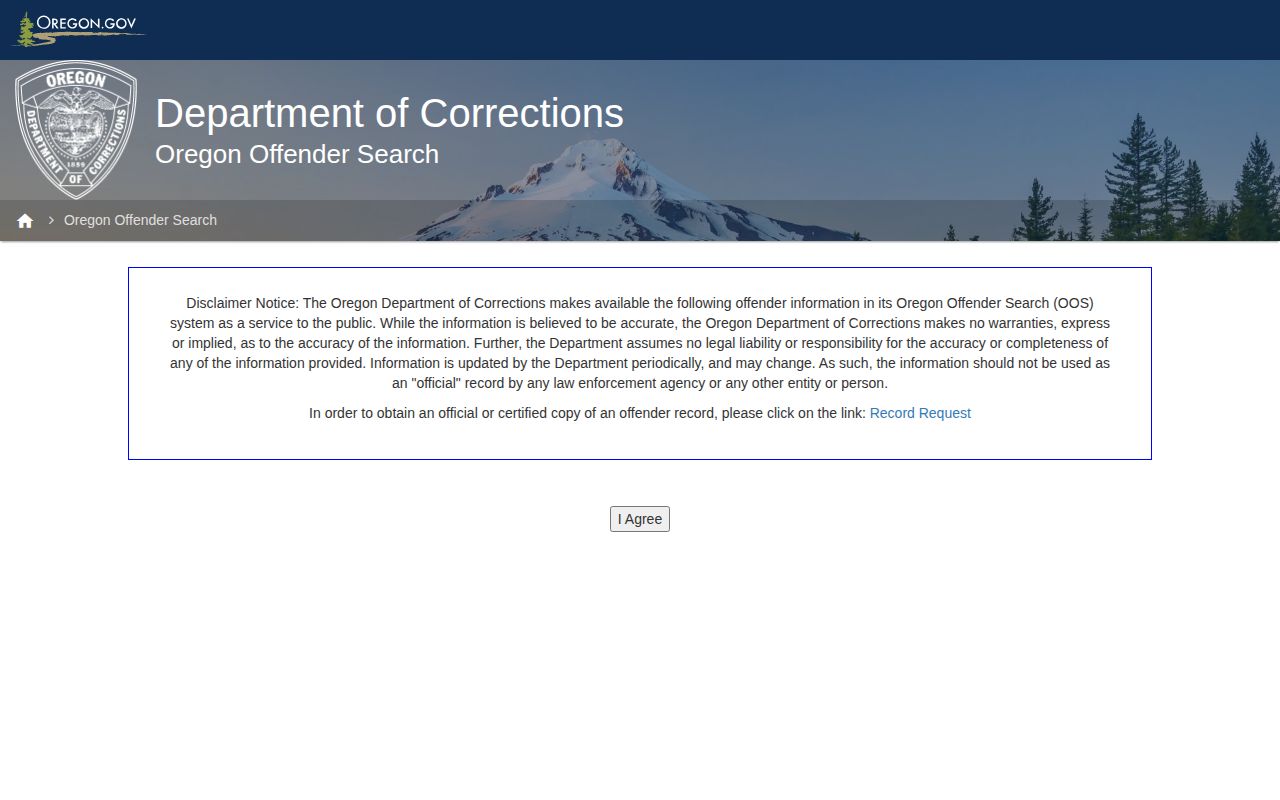
The disclaimer and search fields show why a displayed date must be read with current status and later checked against an official agency record.
Union County Earned-Time Rules
For covered felonies committed on or after November 1, 1989, ORS 421.121 permits reduction of an Oregon DOC adult's institutional term. The statute ties credit to appropriate institutional behavior under DOC rules and participation in adult basic-skills development under ORS 421.084. Its current maximum is 20 percent of the total DOC institutional term, and credit cannot reduce actual confinement below six months.
Eligibility is not an award of the full amount. DOC rules control when credit is granted, retracted, or restored. The statute also lists exclusions, including sentences governed by ORS 137.635, 137.700, 137.707, 163.105, 163.107, and 163.115. The judgment and conviction statute therefore matter more than a broad slogan.
Oregon should not be reduced to an “85 percent” rule. A fully eligible person who receives the current ordinary maximum reduction could serve 80 percent of the DOC institutional term. Other terms receive less credit or none. Any fixed percentage stated without reviewing the offense, judgment, and exclusions may produce the wrong Union County projected release date.
Note: Earned time is governed by the judgment, statute, and DOC award record, not by a simple subtraction from the sentence.
Union County Mandatory Minimum Dates
ORS 137.700, commonly associated with Measure 11, requires listed minimum terms for covered offenses. During that mandatory minimum, the person is not eligible for release on PPS, temporary leave, or a reduction under ORS 421.121 or another statute. The minimum is effectively served at 100 percent. It is not an 85-percent term.
Offense-specific law controls. A roster charge alone does not establish the final conviction or sentence. Charges may be amended, dismissed, or resolved under a different statute. Read the signed judgment, then check the statute named in it. This prevents a date estimate based on an arrest entry from being treated as an agency calculation.
Some older indeterminate, murder, dangerous-offender, life, and other specialized cases involve Board proceedings or additional statutes. Most people convicted after November 1, 1989 have determinate sentences and do not receive a discretionary Board release hearing. A DOC PRD may therefore exist without an entry on the Board calendar.
Union County Jail Date Computation
OOS and VISOR's DOC calculation should not be copied onto a sentence served at UCCF. Union County publishes no local good-time formula. A local date may depend on the signed judgment, credit for time already served, sheriff computation, a weekend or holiday, a court modification, or another authority's hold. Research did not establish a fixed UCCF release hour or a weekend-release rule, so neither should be assumed.
The Union/Wallowa Community Corrections page provides a useful routing distinction. A DOC sentence applies where at least one sentence is 13 months or longer. If no single sentence reaches 13 months, it identifies the Union County Supervisory Authority or local-control setting. That distinction helps determine which custodian to ask, but it is not a release formula.
For a local sentence, use the official UCCF corrections contact to request the computation or release record, then obtain the court judgment. Ask for the anticipated date, the basis used, and whether any hold or transfer changes the result. A court order can authorize release before physical processing is complete, while a detainer can keep the person in custody for another agency. The actual jail record closes that gap.
Union County Release Date Changes
A projected date can move because the facts used in the calculation change. VISOR warns that legal changes may alter some PRDs and that registered users may receive notice. The table identifies the supported causes and the record that can explain each one.
| Factor | Possible effect | Best record to check |
|---|---|---|
| Earned-time award, retraction, or restoration | Moves the DOC calculation within the governing rules | DOC computation or record under ORS 421.121 |
| Mandatory minimum or statutory exclusion | Limits or bars an earned-time reduction | Signed judgment and conviction statute |
| Consecutive or concurrent terms | Changes how multiple terms combine | Judgment and DOC sentence calculation |
| Credit for time served | Changes the remaining term when legally credited | Judgment, court record, and custodian computation |
| Detainer or receiving authority | May prevent community release after one term ends | UCCF or DOC release/transfer record and receiving agency |
| Later court or legal recalculation | Can advance or delay the displayed date | New court order and updated agency record |
A parole grant or denial should not be inserted as a universal row for modern Oregon prisoners. Most modern determinate cases do not use a discretionary release hearing. Where an older or specialized case does involve the Board, obtain the final Board action rather than reading a scheduled hearing as the outcome.
Confirm Union County Actual Release
VISOR can help track a pending change. From the correct individual record, a registrant may choose available notification channels and complete the live confirmation steps. Oregon's current official system supports phone, text, email, and TTY options. Registration is confidential. The Union County VINELink Release Check explains the current VISOR route and its limits.
The official VISOR search and PRD notice illustrates how projected-date information and custody alerts sit in a live status system.
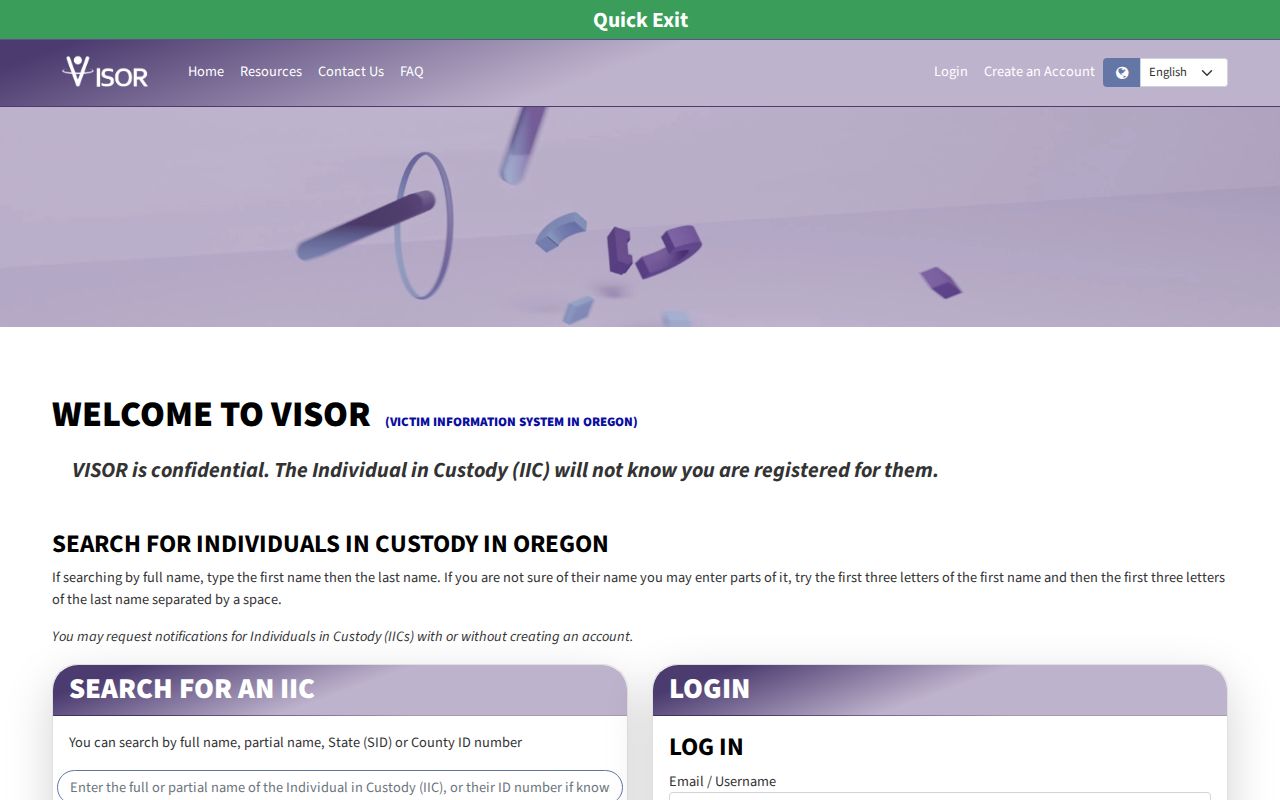
The notice supports checking for recalculation and registering for changes, but the alert still must be reconciled with the responsible jail or DOC record.
After the expected date, verify current status and obtain the actual release record. For UCCF, call the jail and use the UCSO public-records request for the person-specific jail record. The Union County Circuit Court request process supplies the signed judgment when the docket alone is not enough. For Oregon DOC, request a release or discharge record or eligible public pen pack. A community-supervision result can support that secure custody ended while authority continues. “Released” from one system also does not rule out transfer to another county, federal custody, or immigration custody.
The final answer should identify three distinct facts: the prospective date shown before release, the agency and location reporting current status, and the record that confirms what actually occurred. Keeping those facts separate prevents a forecast from becoming a false claim of departure.
Note: A custody-change alert prompts a new check; it does not prove the final destination or end all other holds.