
Union County Three-Day Release Records
The Union County Sheriff's Office offers no verified 72-hour, 48-hour, or general recent-release web view. Its jail-roster landing page sends readers to a dated PDF of current inmates. That PDF is a custody snapshot. It has no filter for a three-day interval, no historical archive, and no release date, type, or destination.
The lack of an online window changes the method. A three-day review must focus on a named person and a defined interval. First preserve the roster's print date. Then ask UCCF whether the person remains there and request the jail record covering the likely dates. Court documents and receiving-agency sources fill in the legal authority or any transfer.
Important: UCSO has not promised a roster update cadence, so a three-day calculation cannot be built from assumed PDF refresh times.
The official roster gateway shown below gives the jail contact and explains the current-list context.
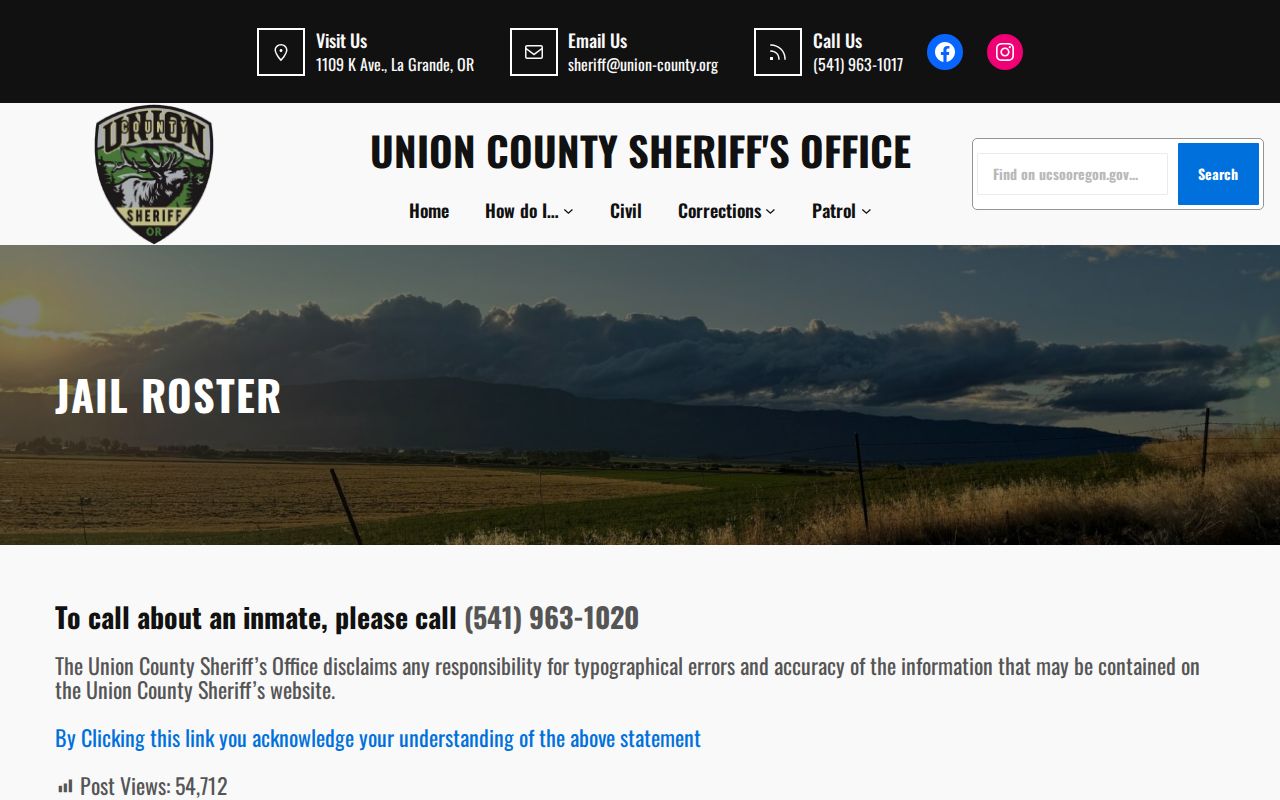
The capture helps identify the official source, but only a person-specific response or record can establish what occurred during the three-day span.
Check Union County 72-Hour Releases
Define the interval before searching. Note the start and end date, the local timezone, and the reason the event is thought to fall within those days. A person may have appeared on a roster printed near the start but left before a later copy. That change is useful context, yet it does not identify release, transfer, or another outcome.
- Open the UCCF current roster and record its print date, the exact name, file number, arrest agency, and charge context.
- Call the Union County Correctional Facility at 541-963-1020. Ask whether the person is still held there and whether a public departure fact can be supplied.
- Submit a focused UCSO records request for the actual release date and time, disposition code, and destination or receiving authority if recorded.
- Search the Oregon court case for the signed release order, dismissal, judgment, or disposition tied to the interval.
- If the result is a transfer, follow the named county, Oregon DOC, federal custodian, immigration authority, hospital, or other receiving system.
Ask for facts, not a custom roster comparison. A useful request gives the full name, inmate/file number if known, approximate arrest dates, and the three-day range. It can seek the booking sheet and actual release fields. That wording narrows the search without claiming that every possible field exists or is open.
Note: Record the time of a phone response because custody information can change before a written record is produced.
Union County 72-Hour Release Fields
A three-day release list would need departure fields that the public PDF does not contain. The roster's “Date Arrest” identifies the entry event. It must not be relabeled as a booking or release date. The table separates visible roster facts from the additional facts needed to confirm a departure during the wider interval.
| Field | Three-day use and limit |
|---|---|
| Person name | Visible on the current PDF; match it with the file number and agency to avoid confusing similar names. |
| Inmate/file number | Visible on the current PDF; the strongest local key for a focused jail-record request. |
| Date Arrest and time | Visible on the current PDF; shows when the arrest event was recorded, not when custody ended. |
| Arrest agency and charge | Visible on the current PDF; helps identify the right court and whether another agency may be involved. |
| Bond information | Visible on the current PDF; does not show that payment cleared every hold or that the person exited. |
| Actual release date and time | Absent from the PDF; request it from UCSO to place the event within the 72-hour interval. |
| Disposition and destination | Absent from the PDF; distinguishes community release, sentence completion, dismissal, transfer, or another movement. |
A release record can answer who left, which custody ended, when it ended, and under what authority or destination. No one Union County screen displays that whole set. Read the jail record with the court order and any receiving-agency result when the sources describe different stages.
Union County Weekend Release Review
A 72-hour span can cover weekend court activity, bail processing, routine jail work, and movement between agencies. It may also cross more than one roster generation. UCSO does not publish a refresh schedule, an after-release retention rule, or a holiday procedure for an online release feed. Do not turn those unknowns into a promised delay or update time.
Instead, anchor each fact to its source. A signed court order can establish legal authority in a case. It may still precede the actual jail exit, especially if processing remains or another hold applies. The UCCF release record is preferred for the physical departure timestamp. If the event involved a transfer, the receiving system must confirm the next custody stage.
The wider window helps when a same-day check was made too soon or when records post in a different order. It does not lower the proof standard. A weekend disappearance from the PDF should be reported as absence from the later snapshot until the disposition is known.
For an event confined to the current day, the Released Last 24 Hours process offers a tighter same-day sequence without treating the roster as a release list.
Union County Roster Release Gaps
The exact local quirk matters. UCSO uses a generated, multi-page PDF instead of a searchable portal. It shows a printed date, name, file number, Date Arrest and time, arrest agency, charge with ORS reference, and bond terms or amount. It lacks a photo, date of birth, case number, court date, release timestamp, reason, destination, prospective date, search control, and archive.
Two snapshots answer only whether a name was displayed on each print date. A removal can result from bail or pretrial release, time served, sentence completion, transfer, another authority's pickup, hospitalization, or a data correction. It may also relate to a separate hold not clear from the displayed charge. The roster cannot select among those outcomes.
Do not synthesize a public three-day list by comparing PDFs. Such a list would assign a release meaning the sheriff did not publish and could misstate transfers as community departures. Preserve only the relevant source context, then obtain the named record. If the release record gives a destination, continue with that custodian before describing the person's overall status.
Note: The roster print date proves document generation on that date, not live updates throughout the prior 72 hours.
Union County Release Order Conflicts
Three-day research often finds records that seem to conflict. Usually, they describe different events. A court may sign an order before UCCF completes release. The roster may drop a name after a transfer while Oregon DOC or another county has not refreshed its data. A federal locator may show the end of one custody system while another authority receives the person.
Use the source closest to each fact. The jail record and timestamp establish departure from UCCF. The signed court order or judgment establishes legal authority in that matter. Oregon DOC's record center supplies an official state release or discharge record, while current OOS or VISOR status can show secure custody or community supervision. A receiving jail or federal agency documents the next custody stage.
If an agency provides only a date, do not invent a time. Keep the retrieval date and exact label. Also keep system identifiers separate unless an official record connects them. A Union County inmate/file number, Oregon SID, court case number, BOP register number, and immigration A-number serve different systems.
Union County Release Custody Routes
County-jail departure is not the same as state-prison discharge. For a person whose case moved into Oregon DOC authority, search Oregon Offender Search by SID when possible and check VISOR. OOS covers people currently in state custody or under local Community Corrections. A community-supervision location can support that prison custody ended, but a full discharge may remove the person from the current system.
VISOR can supply current custody or supervision information and alerts for participating county or state records. A missing result is not release proof. The portal is not a permanent discharge archive, and it does not cover BOP, ICE, or USMS. When an authoritative date is required, request the UCCF or Oregon DOC record tied to the actual event.
Federal custody calls for a separate route. BOP results can establish departure from BOP custody, while ICE's locator mainly addresses current qualifying custody. USMS has no comparable public historical locator. A local transfer to any of these systems is not a community release, even though the person left UCCF during the three-day window.
Document Union County Release Results
Keep the final account as narrow as the evidence. Record each URL, the access time and timezone, the roster print date, the exact name and identifier used, and the label shown by each source. For a call, note the office and whether the answer was informal. For a records request, save the description, estimate, response, and production date.
A person-specific review should also distinguish legal release from physical exit. “Court ordered release” describes the court action. “Released from UCCF at the recorded time” describes the jail event. “Transferred to another authority” describes a custody change without claiming freedom from all custody. “Community supervision” means secure custody ended while correctional authority continues.
For a named person whose history reaches beyond three days, the Union County release-record and search routes bring together archived jail records, court documents, state corrections, notification sources, and federal paths. For the 72-hour question, the conclusion should rest on a dated agency record, a legal disposition plus jail confirmation, or a receiving-custody record. Snapshot absence remains only a clue.