
Union County Supervision Types
Oregon uses several forms of community supervision. Probation is a sentence served in the community under court authority, though a judge may include jail as a condition. Post-prison supervision, often shortened to PPS, follows a prison term in many determinate sentencing cases. Parole is most often the correct term for an older indeterminate case in which the Oregon Board of Parole and Post-Prison Supervision has a date-setting role. Union County's official local explanation places the key dividing date at November 1, 1989. Using the right word matters because it points to the right record and agency.
A pending criminal case creates a fourth status. A person who signs a pretrial release agreement is supervised through case disposition by Union/Wallowa Pretrial Services. That person has left jail under a court agreement, but has not thereby been placed on parole, PPS, or probation. The table separates these paths.
| Status | When it applies | Primary Union County source |
|---|---|---|
| Parole | Chiefly older indeterminate cases, with a Board role based on law at the offense date | OOS or VISOR, Community Corrections, and a final Board action when applicable |
| Post-prison supervision | Community supervision after many later determinate prison terms | OOS or VISOR and Union/Wallowa Community Corrections |
| Probation | A community sentence imposed by a court, sometimes with jail as a condition | Circuit Court judgment and Community Corrections |
| Pretrial release | A signed court release agreement while the charge remains pending | Union/Wallowa Pretrial Services and the court case record |
- Discharge
- The formal end of supervision or sentence authority, shown by the responsible agency or court record.
- Absconder
- A person alleged to have stopped reporting or left supervision without permission. It is not the same as discharge.
- Revocation
- An official decision that ends or changes community release and may return the person to custody.
- Detainer
- A hold or request from another authority that can affect release even when one case permits it.
Verify Union County Post-Release Supervision
No public Union County name-search is offered by the local Community Corrections office. The practical search begins with the Oregon systems and then moves to the office or record custodian that can explain the result. The Oregon Offender Search, or OOS, covers people currently in Oregon DOC custody or under a local Community Corrections office. A person who left prison but remains on parole or PPS may still appear. A fully discharged person may not. A jail-only booking does not make someone an OOS subject.
VISOR also searches people in county or state custody or under supervision. It accepts a full or partial name, SID, or county ID. A community-supervision result supports that secure custody ended while supervision remains active. Since each portal is periodically updated and is not an official historical record, confirm a significant result with the office or source document.
- Decide whether the person had a pending Union County case, a probation judgment, a state-prison term, or an older parole case.
- Search OOS by first, middle, and last name or SID. Name fields allow an asterisk wildcard, while SID does not.
- Search VISOR by name, SID, or county ID. Match identifiers before relying on the displayed custody or supervision status.
- For local parole, PPS, or probation, contact Union/Wallowa Community Corrections. Ask only for information the office is permitted to disclose.
- For pretrial release, check the court case and contact Pretrial Services instead of Community Corrections.
- When the record must show a final outcome, obtain the judgment, probation discharge, DOC release or discharge record, or final Board Action Form.
The broad county custody and release path is also set out on the Union County released inmate search. It helps when the first question is whether a person left UCCF, not which type of supervision followed.
Note: A missing OOS or VISOR result can reflect full discharge, a name mismatch, coverage limits, or an update issue.
Union County Two-County Supervision
Union and Wallowa Counties share a local supervision structure. Union/Wallowa County Community Corrections supervises felony parole, PPS, probation, and person-to-person misdemeanant cases from La Grande. That joint role is a distinctive part of the local record path. A person connected to a Wallowa County matter may still report to the shared office, and the Union County jail roster has displayed Wallowa County matters. Check the court, arrest agency, and assigned office instead of assuming the county name on one document settles jurisdiction.
The office's sentencing explanation also helps identify the system. It states that a DOC sentence applies when at least one sentence is 13 months or longer. When no single sentence reaches that mark, the Union County Supervisory Authority or local-control framework may apply. That rule helps identify the likely custodian of the supervision record, but it does not calculate a release date or prove that supervision remains active.
The screenshot below comes from the official Union/Wallowa Community Corrections page and shows the roles and contact route readers should use.
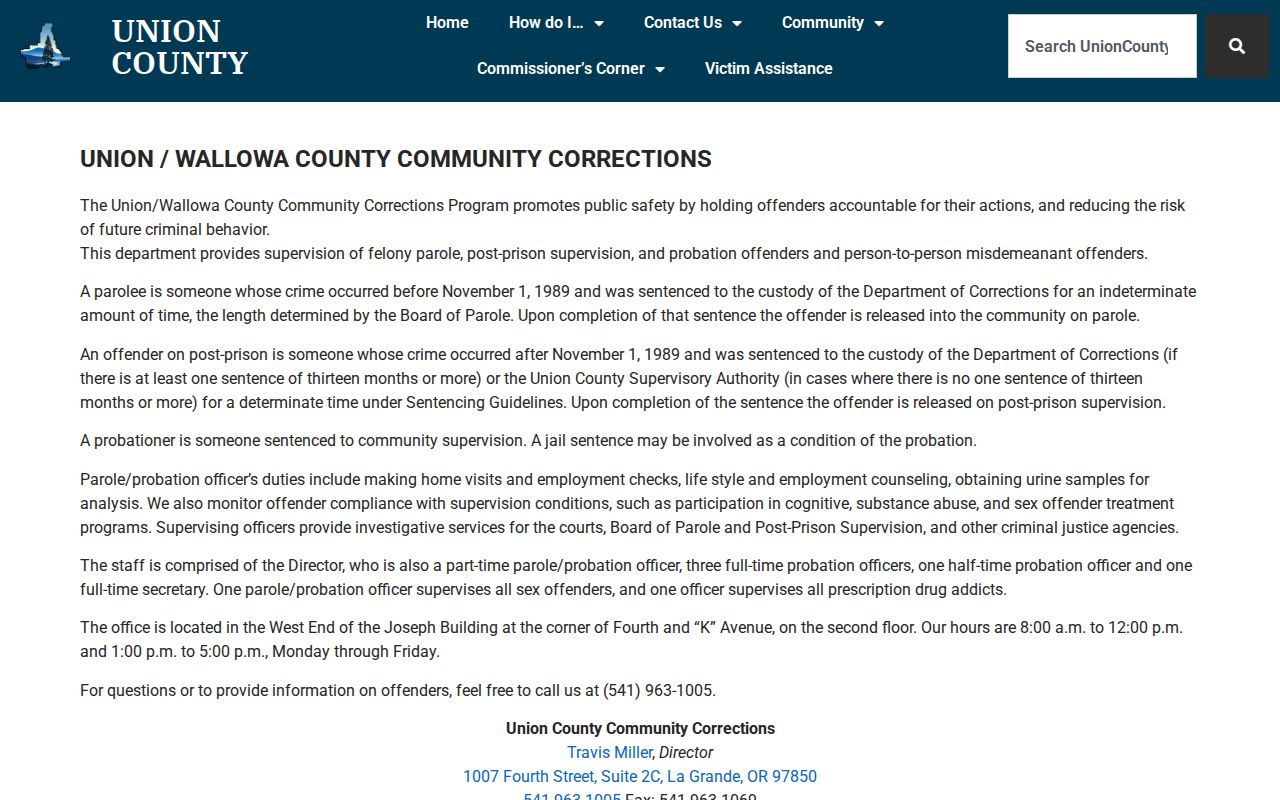
Its two-county scope explains why a status search may lead to a La Grande office even when the underlying case is tied to Wallowa County.
Union County Supervision Offices
Post-conviction supervision and pending-case release use two offices. Community Corrections is at the west end of the Joseph Building at Fourth and K, on the second floor. It closes for the noon hour. Pretrial Services works through the courthouse and uses a different phone and email. Calling the wrong office can lead to a valid but irrelevant answer, so identify whether the person has been convicted before choosing a contact.
Union/Wallowa County Community Corrections1007 Fourth Street, Suite 2C
La Grande, OR 97850
Phone: 541-963-1005
Fax: 541-963-1069
Monday-Friday, 8 a.m.-noon and 1-5 p.m.
Use Community Corrections for current local parole, PPS, probation, or assigned misdemeanant supervision. The office invites calls with questions or information, but its webpage does not provide a public name-search and does not promise release of all case details.
Union/Wallowa Pretrial Services1105 K Avenue
La Grande, OR 97850
Phone: 541-962-9500, option 3 then option 2
Email: D10.Pretrial@ojd.state.or.us
Pretrial Services handles intake, check-in, and supervision under a signed release agreement through disposition. That role ends or changes through the court process, not through a parole discharge.
Note: The Joseph Building office is for post-conviction supervision; the courthouse contact serves people released while a case is still pending.
Union County Supervision Violations
Conditions are the rules attached to release or sentence. They may govern reporting and other conduct, but the exact terms come from the person's judgment, release agreement, supervision record, or Board action. A generic portal result cannot show the full set. An alleged violation can lead to a warrant, revocation, renewed custody, contempt, a sanction, or another official response. Those outcomes are not interchangeable, and none should be inferred merely because a person is no longer visible in a search.
An absconder label means the authority alleges that the person stopped complying or could not be located. It does not mean supervision ended. Research found no official Union County public name-searchable absconder or warrant list. Check OOS and VISOR for the current public status, then contact the supervising office or court. If custody resumes, the responsible jail or DOC record can show that event. VISOR notifications may alert a registrant to a custody or supervision change, but an alert is a prompt to verify, not a final legal record.
Union County Parole Decision Records
The Oregon Board hearing calendar lists scheduled proceedings. It is not a decision database. Most people convicted after November 1, 1989 serve determinate sentences and do not receive a discretionary Board release hearing. The Board may still establish supervision conditions without setting the prison release date. Thus, an OOS or VISOR date can exist with no calendar entry.
Older matrix cases and certain specialized sentences can involve date-setting, parole consideration, exit interviews, murder review, postponement, or future-disposition proceedings. The result depends on the hearing type and law at the offense date. A calendar notice proves only that a hearing was scheduled. The individualized outcome is the final Board action or Board Action Form, often called a BAF.
The official Board records request route supplies the decision record when the public calendar is not enough.
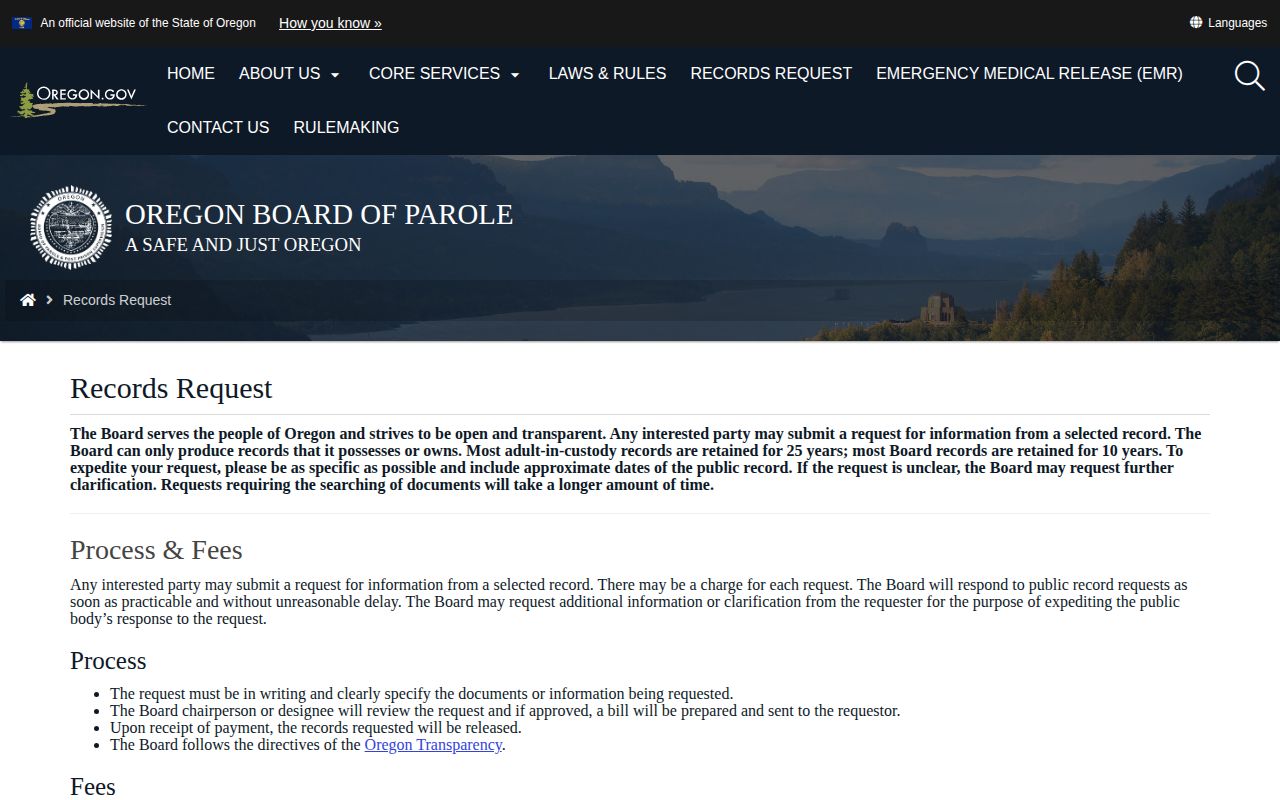
A focused request should identify the person, SID, date of birth, requested record, and relevant dates. That final action is stronger evidence than a scheduled hearing notice.
Union County Supervision Discharge
Supervision ends through an official discharge or other closing action. For probation, the Circuit Court register may show a discharge or satisfaction event, while the signed order gives the firmest detail. For parole or PPS, the responsible corrections or Board record identifies the end of authority. OOS and VISOR are current-status tools, not permanent histories, so a fully discharged person may disappear from them.
When documentation matters, request the source record. Oregon DOC's public-record center can provide eligible public records, including a public pen pack that may contain face sheets, judgments, and some parole discharge or revocation material. Board records can provide the final Board action. The Union County Circuit Court records route supplies a judgment or probation-discharge order. Oregon Public Records Law, ORS 192.311 through 192.478, provides a request framework, but exemptions and other laws may limit confidential or protected content.
Read records in sequence. A UCCF departure record answers when county custody ended. A judgment establishes the sentence. OOS or VISOR may show current community supervision. A discharge record answers when that supervision ended. Together, those sources keep a release from jail, post-release supervision, and final discharge from being collapsed into one event.
Note: Current-status portals are useful leads, while the closing court, DOC, or Board document is the best proof of discharge.